
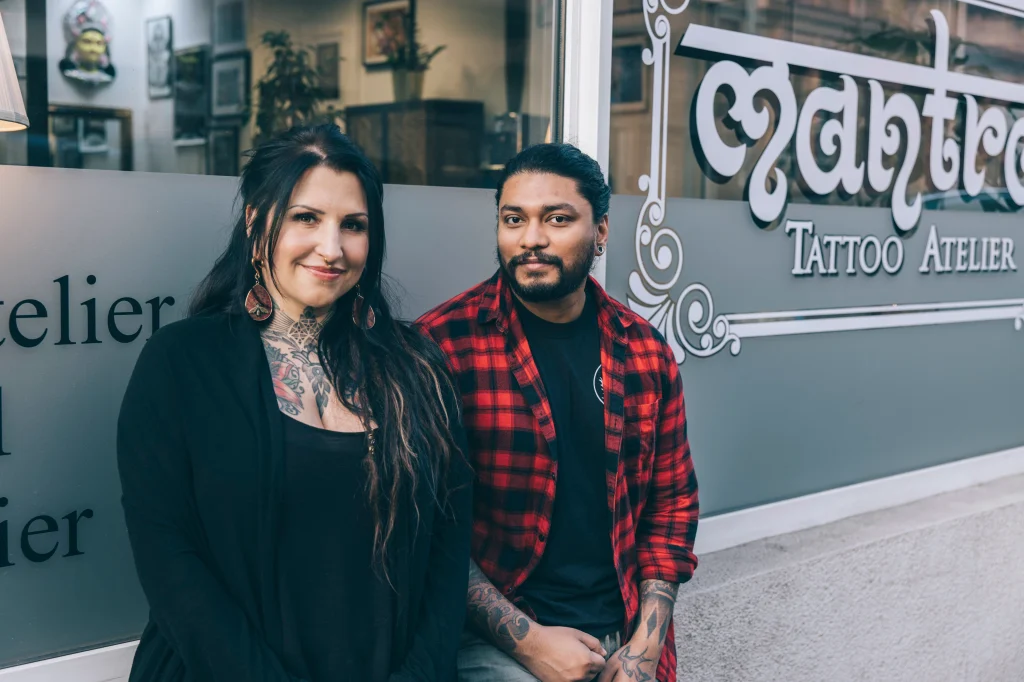
Bhinandan Basu aka Obi lives his dream. At least that could be the general opinion. However, this is a dream that a young man from Calcutta dared to realize. It is the kind of dream that is still almost forbidden for young people from a typical Bengal socio-economic mid-range milieu with all the clichés and the associated pressure from their peers and family members.
In the mid-2000s, when most of Abhinandan’s peers were busy preparing for a life of entrepreneurial slavery, he had a tattoo – out of jokes and dollariness, just as many of us might have. But the puncture of the needle into the skin turned out to be a moment of truth for Abhinandan’s change to Obi. In this case, no damage was done. Instead, the boy from Behala, who stubbornly pursued a little-known, often ridiculed art form over the course of the next decade, is now part of the global elite of tattoo artists, with a studio in Mannheim, Germany, and guest appearances on all the big ones Tattoo conventions, all year round. a dream? sure. But not only that, not just talent. He experienced the blood, sweat and tears Obi shed on his tattoo chair to offer his customers a life-changing personality change, with a society that had absolutely no awareness of a life-changing personality change. world outside their four walls, which threatened long and with their own taboos.
But enough of the history. To be fair, the story is not uncommon. What is not common is the work. What makes Obi stand out from the world of tattoo art, the reason he’s on this blog is his vision. Obis’ distinctive visual language literally leaves a lasting impression in the tattoo landscape of the here and now; And this language is deeply embedded in the over-local cultural language of Bengal, its unmistakable, immediately recognizable Bangaliyaana. And Obi is probably the only one who is doing this at the moment. Read and see for yourself.

Hello Obi, greetings to you, Janine and Pumpkin. How was your quarantine?
Thank you, your greetings were well received and also from us many greetings to you and your family. Luckily, the quarantine season is over here in Germany. We were under strict lockdown for two months, and when the numbers declined and the situation stabilized somewhat, the lockdown was lifted. From May we were allowed to resume the work – of course with some new additional safety regulations. However, the news, which comes from Calcutta and India in general, fills us with concern and fear.
I am pleased that you were able to resume the operation of the Mantra Tattoo Atelier in Mannheim. What will keep you busy for the rest of the year, since traveling will probably never be the same again?
As soon as international travel has normalized a little, I will first visit my parents in Calcutta. I was supposed to visit her in April of this year, but of course that didn’t work out. Apart from that, all the tattoo conventions I usually travel to have been postponed to 2021. All my guest appearances also had to be cancelled. The fact that I can no longer travel is something I still can’t cope with. These are unusual times.
How did the pandemic and the lockdown affect you personally as an artist, apart from the obvious impact on the financial situation of all independent artists?
We are very lucky that our losses were not very great and we were able to resume work so quickly. The famous German efficiency was reflected in the way this pandemic was handled by the government and the people. The state had put together some stimulus packages for entrepreneurs and independent artists who really helped us keep us afloat. Artistic I was moderately productive. I started and finished two paintings, experimented with new media, worked on a number of old projects and designs, cooked a storm in the kitchen, spent time with Pumpkin, and almost finished reading a book I had been trying to read for four years.

What is your philosophy of body art?
She has changed over time. When I started, it was the passion and excitement that brings everything new. This was quickly replaced by the intense desire to be technically adept. At this point, my tattooing philosophy wasn’t much different from that of a carpenter over an armchair. I still believe that tattooing is primarily a craft and only secondarily is an art form. There are very few people who have passed from one to the other without losing anything. My intention is to go the same way.
I turn to people who are willing to radically and irrevocably change their appearance – it’s a limit they want to cross and I’m here to get them across this border. Blood, sweat and tears flow in this process. Getting a tattoo is a cathartic act for many people, and when they’re most vulnerable, they’re lying on my tattoo bed – naked, bleeding, sweating and almost ready to give up. It is my responsibility to share this moment of truth with you and tell you that everything will be fine again. I take this responsibility very seriously.

I read how they got their first tattoo in Bangalore and thus gave their lives a new direction. If you look at her art, especially her strokes, it becomes clear that they have been drawing for years. Have you received a formal art/design education? What or who were your early influences when drawing?
The lines form the backbone of my designs and my tattooing. Trying to draw a perfect line and fail every time is what attracts me most to tattoo every day. I’ve never had a formal art education – where I’m from, it was a privilege that didn’t happen to us – but I’ve been drawing for as long as I can remember. I got that from my mother. I was told that she drew very well during her entire school and study time until life intervened, in the form of marriage and me. However, I never saw her draw. I made all the drawings for my cousins’ biology projects and won a number of Boshe Aankon Protijogitas (seat and drawing competitions) in my neighborhood. At school, I usually aggressively scrawled my textbooks, sometimes to impress the girl next to me, sometimes to drown out the voices that told me a story I didn’t want to hear.
When they started tattooing in 2007, what career path did they find themselves before they made the decision to practice tattooing as a full-time job? When you made that decision, did you visit teachers/mentors from the Indian tattoo industry? What was your learning process like?
I had just finished my BSC in Biotechnology in Bangalore and had since found that biotechnology wasn’t as cool as it sounded when I started. The next step was to perform reasonably well in the CAT exam and be accepted at a reasonably good MBA university. That didn’t work out as planned either. I started tattooing as I was preparing for the CAT exam and finally decided against an MBA course – which I don’t regret. I got my first tattoo while studying in Bangalore. The moment I sat down and the needle touched my skin, I already knew that I had found what I wanted to do for the rest of my life. But I had no idea how to do it. Tattooing wasn’t really an issue back then. There were probably no more than 10-15 professional tattoo artists across the country, and that was only 16-17 years ago.
After college, I returned to Calcutta and took a year off to study for the CAT exam. At that time I started tattooing. At that time there were about three or four people in Calcutta who tattooed. Even as a complete tattoo illiterate, I couldn’t see anything in the works that were done there that prompted me to say: ‘Yes, I would like to learn from this person.’ Some of these tattoo artists had an unnecessarily inflated ego and not the work needed to back it up.
I haven’t really decided to practice this profession, I just did it without making much rational and careful considerations – but I tried to do it to the best of my knowledge and belief, and I’m still trying.
Does a budding tattoo artist have to specialize in a few styles – a kind of must-have – before developing his own distinctive style? Did you specialize in certain tattoo styles when you start?
The recognized way of entering the world of tattoos has always been through a teaching, which basically means that you acquire the knowledge of your master/mentor through physical work, money or both, and in return from him/her he/she taught the tricks of craftsmanship. gets. A proper teaching should teach a person in all aspects of tattooing, not just a specific style – including designing a tattoo, applying to the skin, working the machine, needles and inks, tuning the tattoo machines, hygiene measures, Consultations, aftercare – pretty much anything that helps you run a tattoo studio.
Things have changed now. Information that was once closely guarded is now freely available on the Internet (not everything, but much). Tattoo schools and tattoo academies appear alongside tattoo studios, which in most cases are just another way to benefit from the tattoo boom we are currently experiencing. One can learn the technical aspects of art in such institutions, but what they cannot teach or teach is the love of craftsmanship, the soul, which defines the character of a tattoo artist and ultimately reflects in his work and becomes his personal style.
It takes years of dedicated tattooing to find a style that makes you feel comfortable. When I started, you had to be able to master everything quite well. You had to be quite versatile to be able to assert yourself in a busy street studio, and it is precisely in such street tattoo studios that I have gained my first experiences. That gave me a strong basis that helped me to change my style or.
Tell me more about the stories of how you learned from a former American prisoner and how you accepted your grandmother’s advice – the idea of both sounds fascinating!
Haha, these are really cool stories for an after party at a tattoo convention!
A friend of mine who knew of my interest in tattooing introduced me to a colleague from a call center. Let’s call him K. Well, this K happened to live in my neighborhood and was apparently a tattoo artist. So I went to him and he introduced me to the ‘prison style’ of tattooing, which he had learned during his 12-year imprisonment in a high-security prison in the USA. He didn’t tell me why he was in prison, only that he was traveling with a Mexican gang. For some reason he was deported to India and lived in my neighborhood. In any case, K was tattooed in his room with a homemade prison tattoo apparatus, which basically consisted of a Walkman engine and a sharpened guitar string. The ink was coal mixed with alcohol (at least I hope so). He didn’t really know much about tattooing with a real machine, but he knew the basic things. I got a tattoo of him to get a feel for it, and that was essentially the beginning. Shortly thereafter, another friend helped me by sending me a simple tattoo set. K and I got on my motorcycle and started tattooing people behind hairdressing salons, in dark massage parlors and shabby corners all over Calcutta. At first he tattooed, and I just set up the equipment, drew for him and watched him. After a while I started tattooing some of my friends. The rest, as the saying goes, is history (which is still emerging)!
My grandmother was a spirited woman, typical of most Bengal grandmothers. I had to explain my new career aspirations to my parents and the rest of the family – a process that didn’t go smoothly at all; There were regular arguments and discussions, which I can understand now. One day my grandmother took me aside and told me not to listen to anyone and only do what makes me happy. I listened to her. She passed away a year and a half ago.
Much of your work uses Stippling and Dotwork as methods. Did you have a tendency to develop your own style with these techniques from the start? What about works of art outside of the body; Did you create this meticulously detailed form before your career as a tattoo artist, or at least think about it?
The first time I saw Dotwork or Stippling in tattooing was at the Nepal Tattoo Convention 2011. It was the first international tattoo convention I attended and she really opened my eyes to the huge artistic possibilities in tattooing. It was also a good check on where I stood as a tattoo artist and where I wanted to go. I was lucky enough to meet Kostas, a Greek tattoo artist, at this convention. He specialized in dotwork and I got a tattoo of him. He looked at some of my work, liked this unsuspecting young man from India somehow and shared some of his professional experience with me. I took it as a blessing and started experimenting with the style by trying to do things I didn’t think had been done before.
I experimented with different shades, used many geometric patterns and tried to create optical illusions. It was a very exciting time and my work was recognized in various tattoo magazines and international publications because of its unique appearance and aesthetics. Digital design wasn’t widely used at the time, at least in tattooing, so all my designs were hand-drawn, including the stippling, which took a long time. I still have my little pile of designs from that time.


You seem to practice different tattoo styles. What factors made you want to create your characteristic work – from the popular motifs to the mandalas to the bongo style?
I’m still trying to do a little bit of everything, just to keep things exciting. Comfort is a dangerous drug, and every now and then I like to leave my comfort zone to see if I’m still keen, whether my basics are still withstanding. If not, I focus on the areas I need to work on. The worst thing for me as a tattoo artist is having to turn away a customer – for me that’s a disgrace and a failure that I don’t want to go through. I try to stick to the old rules that force me to give my best to every customer who enters my studio. These rules haven’t let me down so far.

As with the mandala, have you also been interested in sacred geometry from other cultures?
Sacred geometry is a constant in most cultures. Some symbols are common in cultures and tribes that did not have known contact with each other. It’s a fascinating topic. At first I used a lot of sacred geometry, mainly in its linear form to design my designs; Many of my inspirations came from Tibetan art. Gradually, as my understanding of myself and the world around me grew, I felt more and more attracted to ancient Indian geometric shapes.

How did the influences of traditional Chinese and Japanese art come about in you?
Contemporary tattoo art would now be half as much without the contributions of the great Japanese masters. Their control of the body through their Irezumi (“Ink Ink””, the Japanese expression for tattoo), the dedication, the discipline, the willingness to make sacrifices, the understanding of the flow, the telling of stories – the work they have done – forms one of the most important cornerstones of modern tattoo art. In my opinion, it’s almost a necessity for any tattoo artist who really wants to advance to study the works of Japanese masters. You should also study some of the Western masters who have immersed themselves in this genre and have given their own twist. Some of the well-known names in this area are Horiyoshi 3, Horigoro, Horikin, Fillip Leu, Shige, Chris Trevino and Alex Reinke. I’ve always fascinated Japanese tattooing and culture – especially their way of storytelling through tattoos and the one-point focus and dedication for which Japanese are known. It’s not hard to see how Japanese tattoo art has influenced my own style – especially in my large-scale bongo style work. I learned a lot from studying Japanese tattoo art and now apply some of these concepts to my tattoos.


It is interesting to see how seamlessly certain Bengal basics of graphic images, ranging from Kalighat Pata Chitra and the early 20th century graphic art, and of course works by popular artists such as Jamini Roy, the transition to body art in your Tattoos, especially with regard to the Bongo style. You are the only tattoo artist I know who turns this over-local cultural paradigm into a fascinating palette to draw from in body art. How did this process come about?
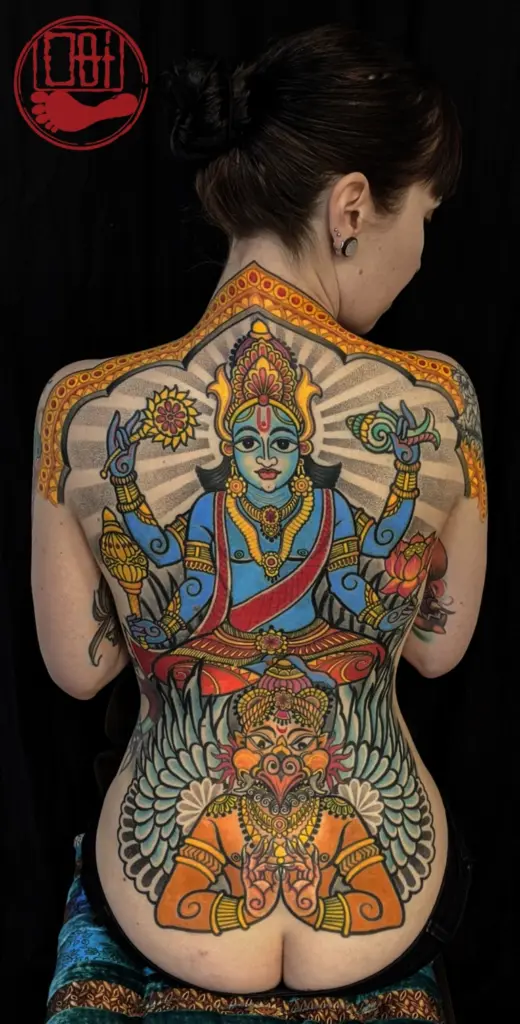
‘Bongo’ is, as you know, our ‘home’ – the style is influenced by a variety of folk and contemporary art forms from Bengal, which include Alpana, woodcut prints, lithographs, murals, Kali Ghat Pata Chitra, Sara (a round clay container) painting and of course works by artists such as Jamini Roy and Nandalal Bose.
It all started with a drawing of a fish. It can’t get any more clichéd for a Bengal than that. I had an unfinished drawing of an Alpana-inspired fish in one of my drawing books – which was only drawn out of boredom and was not meant to be tattooed on someone. At a convention in Phuket, Thailand, in 2015, just before I wanted to pack everything up on the last day, an American lady peering through my drawing books came to me and wanted this fish design to be tattooed on him. It was surprising because I saw that she already had many very high quality tattoos, and the drawing she had chosen wasn’t even finished. She was clearly very good at her tattoo knowledge. But she said she’d never seen a fish design that was like mine. So I tattooed this fish on her – and that’s how the bongo style began.
I began to assimilate influences from various Bengal art forms and recognized the inexhaustible artistic wealth that had remained completely unused in tattooing. But I didn’t just want to copy what already existed, so I started combining different elements with each other. A distinctive look began to emerge, which I could certainly call my own. Shortly thereafter, I started composing my large-scale projects and discussing the possibilities with some of my long-standing customers, some of whom trusted me to radically change their bodies with a genre that was completely new. I will always be grateful for that, because the bongo style would not exist without it. It’s still a work process; I still refine different nuances that make a style waterproof. This includes hours of studying the master’s works, reading materials and history, countless nights of drawing and hundreds of hours bringing the needle into the skin – all to create a template for the next generations to build on and to build a footprint of our people, the Bengal, to leave in the tattoo landscape. My seal/stamp is that of a foot; The alpana footprint of the goddess Lakkhi I saw my mother draw it every year during the goddess’ puja. It’s my way, or our way, to announce that we’re here too.


How did you react when you were selected by Anna Friedman as one of the top three Indian tattoo artists for The World Atlas of Tattoo in 2015?
It was a great moment and opened many doors for me. But it also put a lot of pressure on me to live up to this standard, because I was one of the youngest artists on this list and some of the artists on the list are/my tattoo heroes.
Tell us about your move to Germany and how you and Janine founded the Mantra Tattoo Atelier.
About five years ago I was offered a job in a studio in Germany – I had previously traveled through Europe for guest appearances for about two years. At this point, my work in Europe received much more recognition than in India. During this time I also met my partner Janine – she was a piercing artist at the time. It wasn’t a difficult decision to just grab everything and see where life would take me. Three years later, after my contract with the previous studio had expired, Janine and I decided it was the right time to create our own little room where we would do things our way, and this is how the Mantra Tattoo Atelier came about. It has never been better.


Can there be an unforgettable tattoo experience? Does it have to do with a prominent customer? do you have one
I tattooed Quite a Few Indian celebrities, and most of them were very generous, but my real work exists with the common people. Regular workers who have to work every day and have to save money to get tattooed – they are the ones who help me bring food to the table and wine in the glass – that’s why I celebrate them.
There are far too many stories, but those who are really memorable should probably not be discussed in a public forum.
It is interesting to note that you were there when the emerging tattoo scene in Kolkata was created. However, you never decided to ‘sit down’ with a studio or to start one yourself, like some of your colleagues. How did you have the foresight not to commit yourself at such a young age? Now that you founded Mantra, expansion plans are the next level?
I was young, bankrupt and so passionate about learning this craft that bordered on stupidity and self-destruction. While most of my colleagues sat comfortably in their respective studios and ‘earn’ money, I spent everything I earned on my travels to advance and learn. I remember that some of them even scoffed at the thought of traveling and didn’t understand why I didn’t just want to stay in one place and earn money like they did. Tattooing made me realize dreams almost forbidden for children from my socio-economic background. From the small streets of Behala to the upscale studios in Europe – the fact that I was able to travel, work and earn my living almost anywhere in the world without wearing a uniform or following generally accepted rules gave me a sense of freedom and self-confidence I didn’t want to risk it by opening a studio and having to stay in one place to take care of it, even if it meant economic instability and years of life from a backpack. Although I now have a studio after 12 years in the shop, I still have the freedom to travel and make guest appearances or work on the Convention Circuit. In my opinion, the expansion of the studio in its current form would be an obstacle to it. A tattoo is a very personal and intimate experience, and I think that makes it special and desirable. I’m not a big fan of having multiple branches of a tattoo studio – it’s a tattoo, not a burger.

I have the feeling that the tattoo culture in India has become more mainstream in the last decade, if that’s the opposite of ‘underground’. If anything, there has been an influx of professional tattoo artists who have little idea of the entire subculture; A largely superficial milieu. What do you think of tattoo art today, both as a profession and as a socio-cultural movement in India?
Unfortunately I would have to agree with you. There are several reasons why contemporary electrical tattooing in India has directly transitioned from almost non-existence to absolute mainstream culture without having to go through the underground phase, unlike Europe or other western countries where tattoos have long been part of a Counterculture were and in a way still are – a middle finger against the accepted norms of the beauty and culture of the mainstream society. Tattoo artists were wild men, lawless, modern pirates, people living on the edge. In many countries, tattooing was illegal (tattooing was illegal in New York until 1997; it is still illegal in South Korea, which currently also has one of the world’s most blossoming tattoo scenes), and you really had to want it to to be part of this life. This fight created timeless tattoo styles and brought some of their best artists, artisans and legends to the tattoo world. In India, on the other hand, modern tattooing entered the mainstream culture in the arm of Bollywood celebrities and athletes – embraced by an upper to middle-class, infantile idea of body art. Even today, some of the country’s most popular tattoo artists proudly have photos of themselves as they tattoo celebrities in their portfolio to legitimize their work. It became a dhanda before it could mature into a craft or evolve into an art form. More and more people are attracted to it because they believe it’s quick money. You miss the soul of art. However, it would be unfair to say that all hope is lost – there are some extraordinary talents that come from the subcontinent and will definitely leave their influence on the tattoo landscape in the future. However, their number is painfully low compared to the graduates of tattoo schools.
What do you think of the scene in Kolkata?
I have high expectations of Kolkata – this could be due to my personal bias and I would not pretend that this is not the case. I see a lot of potential among the artists of the city and am often impressed by the work that is being created there. The popular tattoo artists from the city are technically very adept and definitely not lacking in skills or talent. The tattoo culture in the city has made great progress since my time. I was told that there are almost 100 tattoo studios in Kolkata – hardly conceivable because 14 years ago there were zero. But the number of chic studios or tattoo artists is immaterial if the work doesn’t reflect the same variety or standard. Many of the studios are actually not run by artists, but by business owners who treat this like any other business. You can’t expect world-class work from a setup where profit has priority. The infamous Bengali laziness and our excessive dependence on talent could also be a contributing factor.
What would be your advice to young people who want to develop as tattoo professionals in India?
Shut up and tattoos.
